In the 1930s, American soap companies wanted to reach women who spent their afternoons at home with the radio on. So brands like Procter & Gamble paid for daily melodramas, wrapped their detergent ads around the cliffhangers, and gave the genre its name: the soap opera [VERIFY]. India ran the same play in 1984, when Hum Log arrived on Doordarshan with Maggi noodles as its sponsor [VERIFY].
Forty years later, the melodrama is back, this time vertical and on your phone. Microdramas are serial stories cut into episodes short enough to finish before your chai cools, each one ending on a cliffhanger. They have rebuilt the soap opera's oldest bargain: cheap, addictive stories that bring an audience back every single day. And marketers are once again working out how to buy a seat at that table.
What a microdrama actually is
Picture a TV serial put through a juicer. The plots are proudly familiar: The Ken's Debanjali Biswas describes a feed full of rich CEOs chasing damsels in distress. Every episode exists for one purpose, which is to make you watch the next.
The habit is real. A Kantar study for ShareChat and Moj, run in May 2026 with 1,045 smartphone users, found that 86% of viewers watch for more than 15 minutes a day and 75% watch alone. That second number should make every advertiser sit up. A viewer alone with a phone and a cliffhanger is about as captive as audiences get.
The stories come from a factory
So where do all these CEOs come from? Mostly from a fragmented crowd of small production houses that pitch stories to platforms on thin budgets and tighter deadlines.
Pratilipi, an Indian self-publishing platform, spotted the gap. It hosts 21.5 million stories written by its users, and between 5.9 lakh and 7 lakh new ones arrived each month in July and August. When a story shows promise, Pratilipi buys the IP, meaning the rights to adapt it across formats, languages and countries, while the author keeps a royalty share. It then licenses those stories to JioHotstar's Tadka, Amazon MX Player's Fatafat and, since May, TikTok. Its revenue hit Rs 53 crore in Q1 FY27, up 86% year on year.
With 21.5 million stories in the warehouse, plots start behaving like interchangeable parts. Build your own below.
Platforms are building their own story kitchens too. Kuku TV, which The Ken calls India's largest microdrama platform, releases 200 to 300 titles a month and is hiring in-house teams to develop them. (Disclosure: I work at Kuku.) Add the industry's shift towards AI-generated production, and stories keep getting cheaper to make.
Stories
Ads for the apps
Brand money
Tap any box to see who’s involved and where the numbers come from.
Writers
Pratilipi hosts 21.5 million stories written by its users, and 5.9 lakh to 7 lakh new ones arrived each month in July and August. When Pratilipi buys a story, the author keeps a royalty share.
Source: The Ken, 8 Sep 2026
Pratilipi
Buys the IP for stories that work, usually across formats, languages and geographies. It vets stories as text, audio and comics before licensing them as shows. Revenue: Rs 53 crore in Q1 FY27, up 86% year on year.
Source: The Ken, 8 Sep 2026
Platforms
JioHotstar’s Tadka, Amazon MX Player’s Fatafat and, since May, TikTok license stories from Pratilipi. Kuku TV releases 200 to 300 titles a month and is hiring in-house teams to develop its own. The industry is shifting towards AI-generated production.
Source: The Ken, 8 Sep 2026
Viewers
86% watch for more than 15 minutes a day, and 75% watch alone. Based on a Kantar survey of 1,045 smartphone users in May 2026.
Source: ShareChat, Moj and Kantar
Social feeds
Microdrama apps cut their most dramatic moments into ads. 77% of viewers discover microdramas through their social feeds.
Sources: The Ken; ShareChat, Moj and Kantar
Brands
Buy attention around microdramas. The ShareChat study reports 84% brand recall, 79% message association and 82% purchase intent. Read with care: the study comes from a company that sells these ads.
Source: ShareChat, Moj and Kantar
Ad sellers
ShareChat and Moj pitch microdramas to brands as a high-attention environment, and commissioned the Kantar study that backs the pitch.
Source: ShareChat, Moj and Kantar
Where the marketing money walks in
Brands get into microdramas through two doors.
The first door is the trailer. Microdrama apps are heavy advertisers themselves, cutting their most dramatic moments into ads that follow you around social media. Biswas writes that months of tapping "not interested" haven't shaken them off. Each of those ads is a cliffhanger engineered to make you install an app, and it works: the ShareChat study found 77% of viewers discover microdramas through their social feeds.
The second door is the brand slot inside the experience. ShareChat pitches microdramas as a high-attention environment and reports 84% brand recall, 79% message association and 82% purchase intent. Handle those numbers with care, because ShareChat earns money when brands believe them. The underlying logic still holds: a format built to keep you watching makes a natural home for anyone who wants to be seen.
What this tells us
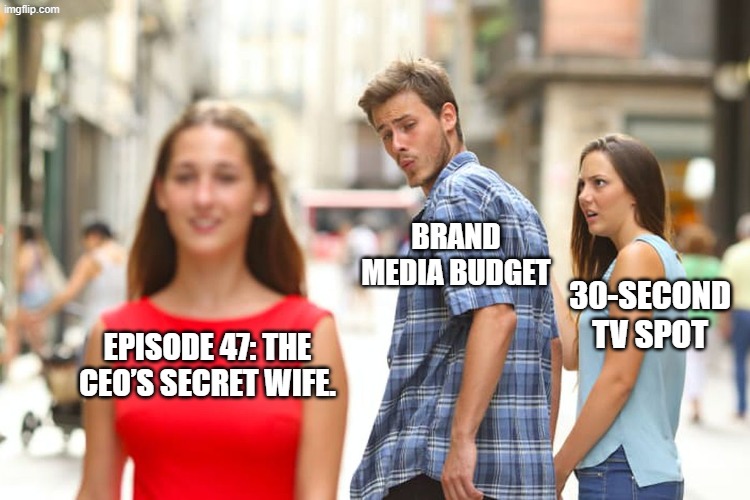
Microdramas show that when stories become cheap and endless, attention becomes the scarce product, and whoever owns the cliffhanger owns the ad slot. P&G learned that on the radio. Indian platforms, story suppliers and ad sellers are learning it again in a 9:16 frame.
- The format sells itself. Microdrama apps market themselves with their own cliffhangers, so the ad and the show are often the same clip. If you work in performance marketing, save these trailers and study how they earn the first few seconds of attention.
- Supply is turning into a data business. Pratilipi vets stories across text, audio and comics before they become shows, so it knows what works before anyone shoots a frame. Learn to read content performance data the way brand managers read sales data, because story selection is becoming a numbers game.
- Vendor research leads the sales pitch. The strongest brand numbers on microdramas come from a company that sells microdrama audiences. Before you recommend any new format to a client, ask who paid for the study and who was surveyed.
P&G once bought the afternoon one cliffhanger at a time. Today's brands are queueing up to buy it one swipe at a time.